
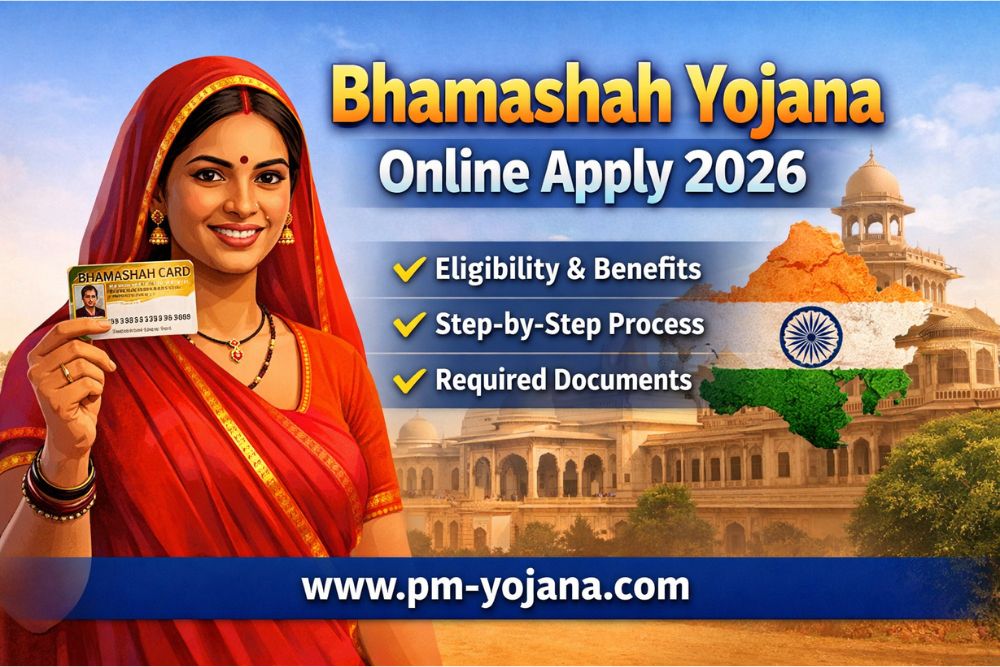
Bhamashah Yojana is a flagship state-level welfare scheme launched by the Rajasthan Government on 15 August 2014 by the then Chief Minister Smt. Vasundhara Raje. The scheme was designed to go beyond the Pradhan Mantri Jan Dhan Yojana by focusing strongly on women empowerment and digital financial inclusion.
Under this initiative, the female head of the family is made the primary cardholder, ensuring that all government benefits are transferred directly to her bank account. In this article by PM Yojana, you will find complete information about Bhamashah Yojana 2026, including benefits, eligibility, documents, online application process, card details, and FAQs.
Overview of Bhamashah Yojana
| Particulars | Details |
| Scheme Name | Bhamashah Yojana |
| Launch Date | 15 August 2014 |
| Launched By | Government of Rajasthan |
| Target Group | All Rajasthan families, especially women |
| Key Objective | Financial empowerment of women |
| Main Cardholder | Female head of the family |
| Card Name | Bhamashah Card |
| Official Website | https://bhamashah.rajasthan.gov.in |
Objectives of Bhamashah Yojana
- To empower women by making them the primary decision-makers in household finances
- To transfer government benefits such as pensions, scholarships, subsidies, and insurance directly to bank accounts
- To ensure transparency through digitization and reduce corruption
- To simplify ration distribution under PDS using QR code and biometric systems
Benefits of Rajasthan Bhamashah Yojana
- Cashless medical facilities for IPD patients
- Coverage for families identified under NFSA and RSBY
- Implemented by the Medical & Health Department, Rajasthan
- Health insurance provided through New India Assurance Company
- Family floater insurance on an annual premium basis
If you are looking for more women-centric government schemes, PM Yojana recommends exploring Ladli Behna Yojana, which also focuses on financial independence for women.
Eligibility Criteria for Bhamashah Yojana
- Applicant must be a resident of Rajasthan
- Family must have a valid Jan Aadhaar or Bhamashah Card
- Family should be registered under NFSA
- A bank account must be opened in the name of the female head of the family
- Economically weaker families are given priority
What Is a Bhamashah Card?
A Bhamashah Card is a multi-purpose smart card issued in the name of the female family head but usable by the entire family. It is linked with Aadhaar and enables beneficiaries to receive multiple government scheme benefits directly into their bank accounts through a single platform. According to PM Yojana, this card plays a crucial role in Rajasthan’s DBT system.
Bhamashah Yojana Online Apply Process
- Visit the official website and select Citizen Registration
- Sign up using Aadhaar, OTP verification, mobile number, and email
- Log in and go to Bhamashah / Jan Aadhaar Enrollment
- Enter basic details and generate a Registration or Enrollment ID
- Fill the complete Bhamashah Yojana online form, including:
- Family member details
- Bank account information
- Aadhaar linking
- Beneficiary details
- Upload the required documents and submit the form
- A receipt number will be generated for tracking
- After document verification, the Bhamashah Card is issued
- Confirmation is sent via SMS/email (processing may take 2–3 months)
Applicants can also log in through the SSO Portal using their Aadhaar or registration number.
Frequently Asked Questions (FAQs)
Q1. What is Bhamashah Yojana?
Bhamashah Yojana is a Rajasthan government welfare scheme aimed at empowering women and ensuring direct benefit transfer of government schemes.
Q2. Does the whole family benefit from the scheme?
Yes, although the card is issued in the woman’s name, benefits apply to the entire family.
Q3. How can I check my application status?
You can track your status via the SSO Portal or the official website using your Aadhaar or registration number.
Q4. What should I do if my Bhamashah Card is lost?
Visit the nearest e-Mitra center to apply for a duplicate card.
Q5. In whose name is the Bhamashah Card issued?
The card is issued in the name of the female head of the family.